Ideal for:
Learners who want the complete experience — from start to certification — with maximum flexibility and support.
Unit 1 – Fundamentals of Occupational Safety and Health Principles and Management Systems
This unit lays the foundation for everything that follows. It explores the core principles, definitions, and purpose of occupational safety and health, explaining why OSH matters — morally, legally, and financially. Learners gain a strong grounding in how effective management systems such as ISO 45001 bring structure and accountability to safety, from leadership and planning to continual improvement.
Unit 2 – Principles and Application of Occupational Safety and Health Risk Management
Here, theory meets practice. Learners move step by step through the risk management process — identifying hazards, assessing risks, applying controls, and monitoring effectiveness. The unit builds confidence in real-world decision-making, emphasizing the hierarchy of control, change management, contractor safety, and emergency planning.
Unit 3 – Principles and Application of Occupational Safety and Health Incident Management
When things go wrong, professionals must know how to respond — and learn. This unit develops that capability. It covers reporting, recording, investigation methods, human and organizational factors, and root cause analysis. Learners discover how to transform incidents into learning opportunities that prevent recurrence and strengthen workplace systems.
Unit 4 – Improving Occupational Safety and Health Performance and Culture
This unit focuses on driving sustained improvement. Learners explore how data, leadership, and communication influence performance, examining tools such as KPIs, audits, and behavioral safety approaches. It highlights how culture, engagement, and trust create workplaces where people take safety personally — and improvement becomes continuous.
Unit 5 – Occupational Health: Protecting the Worker
Health is just as vital as safety. This unit introduces key occupational health concepts — from hazard exposure and ergonomics to stress management and health surveillance. Learners understand how to prevent work-related illness and promote well-being, linking good health to productivity, sustainability, and the long-term success of any organization.
Unit 6 – Exam Preparation and Professional Readiness
The final unit brings everything together. It helps learners prepare for both the knowledge exam and scenario-based assessment with clarity and confidence. Beyond the exam, it reinforces professional ethics, continuous learning, and the personal qualities that define a competent OSH professional — ready to make a real difference in the world of work.
Includes:
✅ Full 18-month access to the DAC Online Learning Portal
✅ Enrollment for the IOSH Level 3 Certificate in Occupational Safety and Health Principles and Practice
✅ Access to all learning videos, assessments, and tutor support
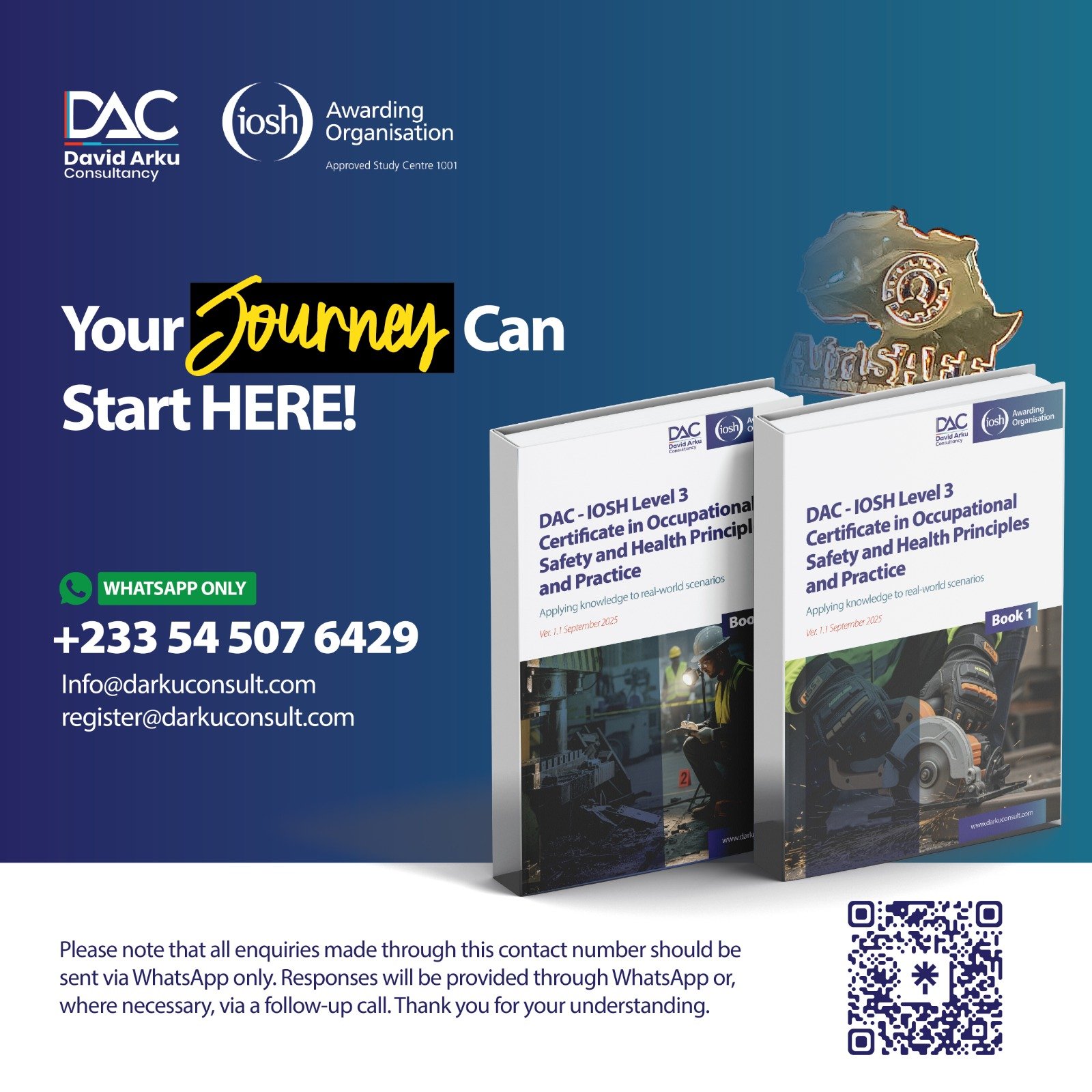
✅ Access to the complete soft copy of the DAC-IOSH Level 3 course book
✅ Exam registration and certificate upon completion
✅ Continuous access to updates and new resources
Welcome to the DAC IOSH Level 3 Certificate. This video introduces the course structure, learning approach, and how to navigate Unit 1.
Introduction to OSH
An overview of occupational safety and health, including key definitions and core principles.
QUESTIONS AND ANSWERS - 1.1
Introduction to OSH
Explores the ethical, legal, and financial reasons organizations must manage health and safety effectively.
QUESTIONS AND ANSWERS - 1.2
Introduction to OSH
Examines how climate change, digitalization, and sustainability are shaping modern OSH practice.
QUESTIONS AND ANSWERS - 1.3
Introduction to OSH
Defines the responsibilities, competencies, and influence of OSH professionals.
QUESTIONS AND ANSWERS - 1.4
Introduction to OSH
Covers health and safety challenges in non-traditional and flexible work models.
QUESTIONS AND ANSWERS - 1.5
OSH Legal and Regulatory Framework
2.1. International, Regional, and National OSH Laws Overview of key OSH legal frameworks at international, regional, and national levels.
QUESTIONS AND ANSWERS - 2.1
OSH Legal and Regulatory Framework
2.2 Employer and Employee Responsibilities Explains the legal and practical health and safety duties of employers and employees.
QUESTIONS AND ANSWERS - 2.2
OSH Legal and Regulatory Framework
2.3 The Role of OSH Committees and Worker Participation Examines how OSH committees and worker involvement support effective safety management.
QUESTIONS AND ANSWERS - 2.3
OSH Legal and Regulatory Framework
2.4 OSH Roles in the Supply Chain and Contractor Management Covers shared OSH responsibilities across supply chains and contractor relationships.
QUESTIONS AND ANSWERS - 2.4
OSH Legal and Regulatory Framework
2.5 AI and Data Privacy in Workplace Monitoring Introduces legal and ethical considerations of AI use and data privacy in workplaces.
QUESTIONS AND ANSWERS - 2.5
OSH Legal and Regulatory Framework
2.6 Sustainability Standards and OSH Explores how sustainability frameworks like ISO 14001 and the UN SDGs support OSH.
QUESTIONS AND ANSWERS - 2.6
OSH Management Systems (OSHMS)
3.1 The Plan-Do-Check-Act (PDCA) Model Introduces the PDCA cycle as a framework for continuous improvement in OSH management.
QUESTIONS AND ANSWERS - 3.1
OSH Management Systems (OSHMS)
3.2 Key OSHMS Standards and Guidelines Explains ISO 45001, ILO-OSH 2001, and HSG65 frameworks for managing OSH systems.
QUESTIONS AND ANSWERS - 3.2
OSH Management Systems (OSHMS)
3.3 Governance, Accountability, and Continual Improvement Covers leadership roles, accountability structures, and continuous improvement in OSHMS.
QUESTIONS AND ANSWERS - 3.3
OSH Management Systems (OSHMS)
3.4 Integrating OSH into Business Strategy Explores how OSH can be embedded into organisational strategy and decision-making.
QUESTIONS AND ANSWERS - 3.4
Risk Management Principles
Video_DAC_Unit 2_4.1
QUESTIONS AND ANSWERS - 4.1
Video_DAC_Unit 2_4.2
QUESTIONS AND ANSWERS - 4.2
Video_DAC_Unit 2_4.3
QUESTIONS AND ANSWERS - 4.3
Video_DAC_Unit 2_4.4
QUESTIONS AND ANSWERS - 4.4
Video_DAC_Unit 2_4.5
QUESTIONS AND ANSWERS - 4.5
Video_DAC_Unit 2_4.6
QUESTIONS AND ANSWERS - 4.6
Video_DAC_Unit 2_4.7
QUESTIONS AND ANSWERS - 4.7
Video_DAC_Unit 2_4.8
QUESTIONS AND ANSWERS - 4.8
Workplace Inspections and Audits
Video_DAC_Unit 2_5.1
QUESTIONS AND ANSWERS - 5.1
Video_DAC_Unit 2_5.2
QUESTIONS AND ANSWERS - 5.2
Video_DAC_Unit 2_5.3
QUESTIONS AND ANSWERS - 5.3
Video_DAC_Unit 2_5.4
QUESTIONS AND ANSWERS - 5.4
Common Workplace Hazards and Controls
Video_DAC_Unit 2_6.1
QUESTIONS AND ANSWERS - 6.1
Video_DAC_Unit 2_6.2(a)
Video_DAC_Unit 2_6.2(b)
Video_DAC_Unit 2_6.2(c)
Video_DAC_Unit 2_6.2(d)
Video_DAC_Unit 2_6.2(e)
Video_DAC_Unit 2_6.2(f)
Video_DAC_Unit 2_6.2(g)
Video_DAC_Unit 2_6.2(h)
Video_DAC_Unit 2_6.2(i)
Video_DAC_Unit 2_6.2(j)
Video_DAC_Unit 2_6.2(k)
Video_DAC_Unit 2_6.2(l)
Video_DAC_Unit 2_6.2(m)
Video_DAC_Unit 2_6.2(n)
Video_DAC_Unit 2_6.2(o)
Video_DAC_Unit 2_6.2(p)
QUESTIONS AND ANSWERS - 6.2
Video_DAC_Unit 2_6.3
QUESTIONS AND ANSWERS - 6.3
Video_DAC_Unit 2_6.4
QUESTIONS AND ANSWERS - 6.4
QUESTIONS AND ANSWERS - 6.5
QUESTIONS AND ANSWERS - 6.6 (A)
QUESTIONS AND ANSWERS - 6.6 (B)
QUESTIONS AND ANSWERS - 6.6 (C)
QUESTIONS AND ANSWERS - 6.6 (D)
QUESTIONS AND ANSWERS - 6.6 (E)
QUESTIONS AND ANSWERS - 6.6 (F)
QUESTIONS AND ANSWERS - 6.6 (G)
QUESTIONS AND ANSWERS - 6.6 (H)
QUESTIONS AND ANSWERS - 6.6 (I)
QUESTIONS AND ANSWERS - 6.6 (J)
QUESTIONS AND ANSWERS - 6.6 (K)
QUESTIONS AND ANSWERS - 6.6 (L)
QUESTIONS AND ANSWERS - 6.7
QUESTIONS AND ANSWERS - 6.8
7. Incident Causation and Investigation
7.1 Theories of Accident Causation Introduces key theories explaining how and why workplace accidents occur.
QUESTIONS AND ANSWERS - 7.1
7. Incident Causation and Investigation
7.2 Why Incidents Really Happen Explores underlying factors that contribute to incidents beyond immediate causes.
QUESTIONS AND ANSWERS - 7.2
7. Incident Causation and Investigation
7.3 Root Cause Analysis and Incident Investigation Covers methods for identifying root causes and conducting effective investigations.
QUESTIONS AND ANSWERS - 7.3
7. Incident Causation and Investigation
7.4 Building an Incident Investigation Team Explains how to select and structure a competent investigation team.
QUESTIONS AND ANSWERS - 7.4
7. Incident Causation and Investigation
7.5 Skills and Ethics of Interviewing Witnesses Focuses on ethical, effective techniques for interviewing witnesses after incidents.
QUESTIONS AND ANSWERS - 7.5
7. Incident Causation and Investigation
7.6 AI-Driven Incident Investigations and Digital Forensics Introduces the use of AI tools and digital evidence in modern incident investigations.
QUESTIONS AND ANSWERS - 7.6
8. Incident Reporting and Compliance
8.1 Internal vs. External Reporting Explains differences, requirements, and purposes of internal and external incident reporting.
QUESTIONS AND ANSWERS - 8.1
8. Incident Reporting and Compliance
8.2 Legal and Ethical Issues in Workplace Surveillance Examines legal and ethical considerations of surveillance used for incident reporting.
QUESTIONS AND ANSWERS - 8.2
9. Human Factors in Incident Causation
9.1 Behavioral Health and Safety and Human Error Explores how human behavior and error influence workplace safety outcomes.
QUESTIONS AND ANSWERS - 9.1
9. Human Factors in Incident Causation
9.2 HSG48 – Reducing Error and Influencing Behavior Provides a simplified overview of HSG48 principles for managing human factors.
QUESTIONS AND ANSWERS - 9.2
Health & Safety Leadership and Stakeholder Management
10. Health & Safety Leadership and Stakeholder Management Explores leadership approaches and stakeholder engagement in effective OSH management. 10.1 Leadership Styles in OSH Examines different leadership styles and their impact on health and safety performance.
QUESTIONS AND ANSWERS - 10.1
10.2 Engaging Employees in OSH Initiatives Covers practical ways to involve employees in improving workplace safety.
QUESTIONS AND ANSWERS - 10.2
10.3 Stakeholder Mapping and Influence in OSH Explains how to identify stakeholders and manage their influence on OSH outcomes.
QUESTIONS AND ANSWERS - 10.3
QUESTIONS AND ANSWERS - 10.4
10.5 Conflict Management and Resistance to OSH Change Explores techniques for managing conflict and overcoming resistance to safety initiatives.
QUESTIONS AND ANSWERS - 10.5
10.6 Ethical Leadership in Health & Safety Management Highlights the importance of ethics and integrity in OSH leadership decisions.
QUESTIONS AND ANSWERS - 10.6
10.7 Contractors and Third-Party OSH Responsibilities Examines shared OSH duties when working with contractors and third parties.
QUESTIONS AND ANSWERS - 10.7
Developing a Positive Health & Safety Culture
11. Developing a Positive Health & Safety Culture Introduces key concepts for building and sustaining a strong safety culture. 11.1 Safety Culture vs. Safety Climate Explains the differences between safety culture and safety climate.
QUESTIONS AND ANSWERS - 11.1
11.2 Measuring and Improving Safety Culture Covers models and tools for assessing and improving safety culture.
QUESTIONS AND ANSWERS - 11.2
11.3 Addressing Cultural Resistance and Unsafe Behaviors Focuses on identifying and managing negative behaviors and resistance to safety.
QUESTIONS AND ANSWERS - 11.3
11.4 Just Culture Introduces the principles of fairness and accountability in safety management.
QUESTIONS AND ANSWERS - 11.4
11.5 Behavioral-Based Safety (BBS) Explains how behavior-based approaches can improve safety performance.
QUESTIONS AND ANSWERS - 11.5
11.6 Sustainability-Focused Safety Culture (Green OSH) Explores how sustainability principles support long-term OSH culture.
QUESTIONS AND ANSWERS - 11.6
Measuring OSH Performance
12. Measuring OSH Performance Explains how to evaluate and improve OSH performance using data and metrics. 12.1 Leading vs. Lagging Indicators Compares proactive and reactive indicators of OSH performance.
QUESTIONS AND ANSWERS - 12.1
12.2 OSH KPIs Selection and Implementation Covers how to choose and apply effective OSH key performance indicators.
QUESTIONS AND ANSWERS - 12.2
12.3 Auditing and Reviewing OSH Performance Explains internal audits and management reviews for continuous improvement.
QUESTIONS AND ANSWERS - 12.3
12.4 Benchmarking OSH Performance Introduces benchmarking methods to compare OSH performance.
QUESTIONS AND ANSWERS - 12.4
QUESTIONS AND ANSWERS - 12.5
12.5 AI-Powered Safety Analytics and Predictive Risk Monitoring Explores the use of AI to analyse safety data and predict risks.
Multiple-Choice Knowledge Exam
14.1 Exam Structure and Key Facts Explains the exam format, timing, and key assessment requirements.
14.2 Question Styles and What They Test Covers different MCQ styles and the knowledge areas they assess.
14.3 Common Pitfalls and How to Avoid Them Highlights common mistakes and strategies to avoid them in the exam.
14.4 Answering Techniques Introduces effective techniques for analysing and answering MCQs accurately.
14.5 Practice Questions with Worked Explanations Includes sample questions with step-by-step explanations to support learning.
Scenario-Based Practical Assessment
15.1 Assessment Structure and Key Facts Outlines assessment requirements, marking criteria, and submission guidance.
15.2 Scenario: Small Manufacturing Workshop Introduces the assessment scenario used for practical application tasks.
15.3 Workplace Inspection Task Guides learners through conducting and recording a workplace inspection.
15.4 Risk Assessment Task Explains how to identify hazards, assess risks, and propose control measures.
15.5 Incident Investigation Task Covers investigation steps, evidence gathering, and reporting requirements.
15.6 Toolbox Talk Preparation Task Guides learners on preparing and delivering an effective toolbox talk.
15.7 Time Management and Presentation Tips Provides tips on managing time and presenting assessment work clearly.
General Exam Preparation Tips
16.1 Preparing in the Weeks Before the Exam Covers study planning, revision strategies, and self-assessment techniques.
16.2 On the Day of the Exam Provides practical advice on exam-day preparation and performance.
A comprehensive guide to conduct rules, technical requirements, and strategies for exam success.
A step-by-step guide from registration to exam submission based on official IOSH guidance

Dr. David Arku is a seasoned Occupational Health and Safety professional with extensive experience in workplace safety, health systems, and organizational development. As the CEO of DAC Consultancy and a certified IOSH course leader, he is passionate about empowering professionals to build competence, improve safety culture, and achieve global standards in HSEQ excellence.
No Review found
Discover Additional Learning Opportunities
 Advance
Beginner
Advance
Beginner
-01.png)